AMS Recognizes Poster Award Winners at Northwest Arkansas Regional Meeting
The Arkansas Medical Society recognized six poster award winners at its Northwest Arkansas Regional Meeting on October 8 in Springdale. The honorees represented the University of Arkansas for Medical Sciences (UAMS) and the Alice Walton School of Medicine (AWSOM), with presentations addressing medical education, clinical care, prevention and patient support.
Held at Sassafras Springs Vineyard & Winery and co-hosted by the Washington County Medical Society, the meeting brought together more than 200 practicing physicians, residents, medical students and faculty. Poster presentations gave participants an opportunity to share their work with colleagues from across the region.
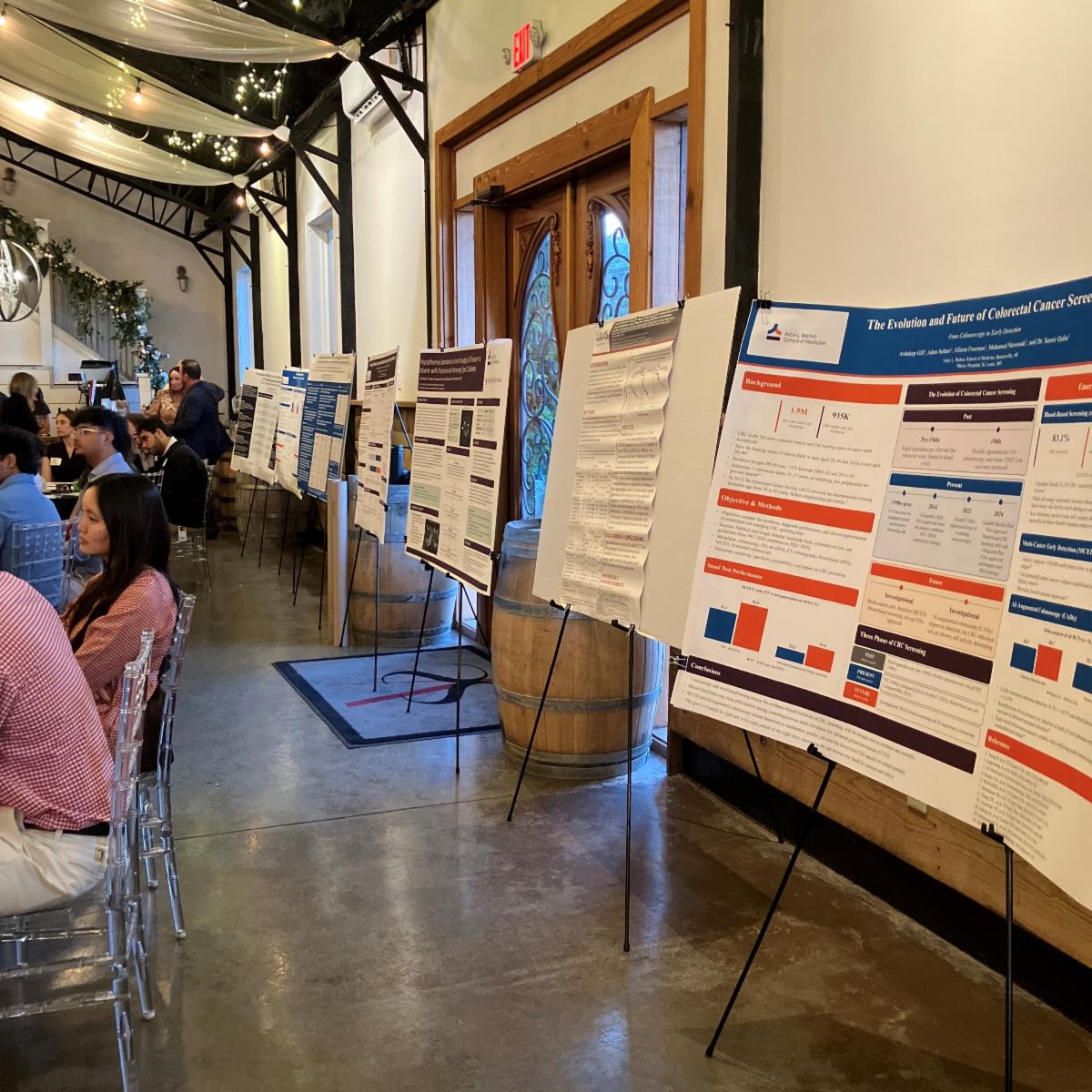
Poster Award Winners
The abstracts below are reproduced as submitted.
First Place
Dr. Sydney Jacob, UAMS
Title: Identifying and Addressing the Gaps in Procedure Education
Objectives: New residencies in Arkansas must completely restructure their hospital’s policies and culture to incorporate resident education, which can be incredibly difficult. Using a systematic resident-flow investigation grounded in LEAN Healthcare practices, we were finally able to answer the question, “Why aren’t my residents getting signed off?”
Methods: From October 2025 to September 2025, a small team using Lean Healthcare methodologies identified flow delays and underlying barriers that prevented residents at a mid-sized Midwest hospital from performing procedures. The team selected five procedures identified by the Journal of Hospital Medicine as “Core Competencies of Hospital Medicine” for investigation. We collected data through surveys, policy reviews, and discussions with faculty and hospital staff.
Results: Process mapping and data review in October of 2025 revealed gross variability in resident and faculty understanding of the sign-off process, as well as what it means to be signed off, low levels of resident reported self- confidence in performing procedures, even when signed off, and multiple barriers to achieving requirements to get signed off. These barriers included a lack of educational resources, limited procedure opportunities, faculty and resident time constraints, and documentation failures.
Conclusion: The primary barriers to procedure performance in young residency programs likely come down to a lack of standardization and clear communication, a lack of resources, and a lack of procedure opportunities. Next steps are in motion at this facility, including clarification of sign-off requirements with re-education of residents and teaching faculty, creation of a resident educational resource bank, creation of standardized rubrics for procedure evaluations, a standardized recurrent SIM Schedule with opportunities to practice with task trainers, and a restructuring of the resident flow pathway to create more procedure opportunities.
Mohamed Messouak, AWSOM
Manuscript Title: Early Interventional Radiology Drainage and 90-Day Mortality in Clinically Drainable Infections: A Retrospective Claims-Based Cohort Study
Authors: Mohamed Messouak BS1, Samantha Hong BS1, Preston Bailey BS1, John Garrett, MD3 Ehsan Yaghmaei PhD2, Mohammadreza Rezaei MS2, Cyril Rakovski PhD2, Shahrzad Bazargan-Hejazi PhD1
Background: Image-guided interventional radiology (IR) drainage is widely used for clinically drainable infections, yet population-level evidence on its association with mortality remains limited.
Objectives: To evaluate the association between early IR drainage and 90-day all-cause mortality among patients with clinically drainable infections.
Methods: We conducted a retrospective cohort study using IQVIA administrative claims data (2019 through mid-2025). Patients aged 0–84 years with clinically drainable infections were identified using ICD-10-CM codes. Early IR drainage was defined as image-guided catheter-based drainage within 14 days of the index infection diagnosis. The primary outcome was 90-day all-cause mortality. Crude and adjusted associations were estimated using inverse probability of treatment weighting combined with outcome regression in a doubly robust framework, adjusting for age, sex, comorbidity burden, and infection type.
Results: Among 63,068 patients, 8,965 (14.2%) received early IR drainage. Crude 90-day mortality was 2.52% with early IR drainage versus 1.45% without (risk difference [RD], 1.08 percentage points; risk ratio [RR], 1.74). After adjustment, mortality was 2.12% versus 1.58% (RD, 0.54 percentage points; 95% CI, −0.12 to 1.53; RR, 1.34; 95% CI, 0.93–1.97). Sensitivity analyses using 7-day and 30-day exposure windows yielded directionally consistent results.
Conclusions: After doubly robust adjustment, early IR drainage was not significantly associated with 90-day mortality. Substantial attenuation from crude to adjusted estimates and null-inclusive confidence intervals suggest the observed association likely reflects patient complexity and treatment selection rather than procedural harm; however, residual confounding by unmeasured disease severity cannot be excluded.
Second Place
Lily G. DeSpain, UAMS
A Proposed Reassessment Framework for Persistent Tinea Pedis in Military Personnel: An Antifungal Stewardship Framework
Lily G. DeSpain, University of Arkansas for Medical Sciences
Background. Tinea pedis is common in military populations, but persistent symptoms after treatment do not establish antifungal resistance. In settings with limited access to mycologic testing or dermatology consultation, repeated empiric treatment may delay recognition of diagnostic error, inadequate treatment, reinfection, or an untreated reservoir.
Methods. A targeted narrative review of military epidemiology, tinea pedis diagnostic studies, and North American dermatophyte resistance reports that were identified through PubMed/MEDLINE and reference review through September 8, 2026 was conducted. The evidence was then used to develop a proposed, stepwise reassessment framework for military clinics. The framework has not been implemented or validated.
Findings. A meta-analysis of 25 military studies estimated pooled tinea pedis prevalence at 17% (95% CI, 12%–23%). In one soldier cohort, clinical point prevalence exceeded mycologically confirmed prevalence (60.1% versus 27.3%), underscoring diagnostic uncertainty. The reassessment was organized into five questions: (1) Does the morphology support dermatophytosis, or is a mimicker more likely? (2) Was an appropriate antifungal used for an adequate duration and with feasible adherence? (3) Did disease persist throughout treatment or recur after improvement? (4) Are toenails or other sites potential fungal reservoirs? (5) Does verified treatment failure, extensive disease, or epidemiologic context justify mycologic testing and specialty input? Published resistance findings support selective escalation but do not establish the prevalence of resistant tinea pedis in U.S. service members.
Conclusion. This proposed framework shifts the assessment of apparent treatment failure from automatic retreatment toward documenting the diagnosis, actual regimen, recurrence pattern, and possible reservoirs before escalating care. Prospective evaluation should evaluate its feasibility, diagnostic yield, and effects on repeat visits and duty limitations in military clinics.
Selected References.
Sepahvand A, Behzadifar M, Raiesi O, Yarahmadi M. Prevalence of Tinea pedis in military personnel: a systematic review and meta-analysis. BMC Public Health. 2025;25(1):3116. Published 2025 Sep 24. doi:10.1186/s12889-025-24308-5
Cohen, A.D., Wolak, A., Alkan, M., Shalev, R. and Vardy, D.A. (2005), Prevalence and risk factors for tinea pedis in Israeli soldiers. International Journal of Dermatology, 44: 1002-1005. https://doi.org/10.1111/j.1365-4632.2005.02281.x
Cañete-Gibas CF, Mele J, Patterson HP, et al. Terbinafine-Resistant Dermatophytes and the Presence of Trichophyton indotineae in North America. J Clin Microbiol. 2023;61(8):e0056223. doi:10.1128/jcm.00562-23
Saso Krstovski Jr., AWSOM
“LEVEL UP FOCUS”: Gamifying ADHD Support for Children (Ages 6-12)
Saso Krstovski Jr.
ABSTRACT
Attention-Deficit/Hyperactivity Disorder (ADHD) affects children’s executive functioning, motivation, and sustained attention, often making traditional learning and therapeutic methods less effective. This project proposes a gamified intervention framework designed to enhance engagement, regulate attention, and support behavioral self‑management in children with ADHD aged 6-12. Grounded in cognitive neuroscience, motivational psychology, and learning science, the framework integrates reward loops, adaptive difficulty, immediate feedback, and narrative-based progression, which are mechanics shown to improve dopamine-mediated motivation pathways that are often dysregulated in ADHD.
The proposed system combines digital micro-games, physical movement-based challenges, and structured real-world routines, each mapped to core executive function targets such as inhibitory control, working memory, task initiation, and emotional regulation. A companion dashboard for caregivers, educators, and clinicians enables real-time monitoring of performance trends and behavioral patterns, supporting individualized interventions.
Technically, the platform leverages a modular architecture: (1) a machine-learning personalization layer adjusting difficulty based on performance variability, (2) a behavior-scoring engine linked to clinically validated rating scales, and (3) a cross-context token economy that reinforces real-world behaviors through virtual rewards. The research design includes a mixed-methods evaluation across school and home settings, using randomized controlled components, ecological momentary assessments, and longitudinal tracking to measure improvements in attention, compliance, and emotional resilience.
This project aims to provide a scalable, evidence-informed gamification model that aligns with therapeutic best practices while meeting children where they naturally thrive in interactive, play-driven environments. The findings will inform future digital therapeutics and contribute to ongoing discourse on technology-supported ADHD care.
Third Place
Arshdeep Gill, AWSOM
Title: The Evolution and Future of Colorectal Cancer Screening: From Colonoscopy to Early Detection
Background: Colorectal cancer (CRC) is the second leading cause of cancer death worldwide and the third leading cause of cancer death among men and women in the United States. Rising CRC incidence in younger adults has increased the need for accessible and effective screening. This review compares the evolution, diagnostic performance, and clinical implementation of established and emerging CRC screening modalities.
Methods: A literature review was conducted using PubMed and Google Scholar, including landmark studies, systematic reviews, and guidelines published since 1967. Screening modalities reviewed included colonoscopy, fecal immunochemical testing (FIT), multitarget stool DNA (mt-sDNA), CT colonography, circulating tumor DNA (ctDNA) assays, multi-cancer early detection (MCED) platforms, and artificial intelligence (AI)-assisted colonoscopy.
Results: Colonoscopy and stool-based testing remain the foundation of CRC screening through early cancer detection and removal of precancerous lesions. Blood-based ctDNA assays may improve screening uptake because they are less invasive but have limited sensitivity for advanced precancerous lesions. AI-assisted colonoscopy improves adenoma detection rates and may enhance procedural quality.
Conclusion: Although blood-based screening expands access, colonoscopy and stool-based testing remain the most effective approaches for CRC prevention. Future strategies will integrate precision medicine and AI to improve early detection and reduce CRC burden.
Special Prize
Emily Bunch, AWSOM
Title: Polycythemia Secondary to a Sertoli-Leydig Cell Tumor in a Patient with Porphyria and Worsening Type 2 Diabetes.
Introduction
Sertoli-Leydig cell tumors (SLCTs) are rare ovarian sex cord-stromal neoplasms that may secrete androgens and present with virilization. Polycythemia is an uncommon consequence of androgen excess and may represent an overlooked presenting feature of androgen-secreting tumors.
Recognition may be delayed in patients with complex chronic medical conditions when new symptoms are attributed to preexisting diagnoses. We report a testosterone-secreting SLCT discovered during workup of unexplained polycythemia in a woman with acute intermittent porphyria and insulin-requiring type 2 diabetes mellitus, highlighting an uncommon presentation of tumor-associated hyperandrogenism.
Case Presentation
A female with a history of acute intermittent porphyria and insulin-requiring type 2 diabetes mellitus underwent evaluation for secondary polycythemia and progressive clinical manifestations of hyperandrogenism. Laboratory evaluation demonstrated markedly elevated total testosterone levels measuring as high as 300 ng/dL at presentation to 515 ng/dL with repeat testing. Preoperative hemoglobin and hematocrit were elevated at 16.3 g/dL and 48.9%, respectively. Pelvic ultrasonography identified a 3.5 x 2.8 x 2.8 cm heterogeneous, hypervascular right ovarian mass, with findings confirmed on MRI. Following multidisciplinary evaluation, the patient underwent surgical resection. Histopathologic examination demonstrated a 5-cm intermediate-grade Sertoli-Leydig cell tumor confined to the ovary with an intact capsule and negative lymph node sampling (pT1a). Following resection, total testosterone normalized to 15 ng/dL and hemoglobin/hematocrit improved to 13.8 g/dL and 40.2%.
Outcome
The marked decline in total testosterone following tumor resection provided biochemical confirmation of a hormonally active androgen-secreting neoplasm and correlated with substantial clinical improvement. Total testosterone normalized from 515 ng/dL to 15 ng/dL following surgical resection. Hemoglobin and hematocrit likewise improved from 16.3 g/dL and 48.9% to 13.8 g/dL and 40.2%, respectively. The patient reported marked improvement in hyperandrogenic symptoms, overall functional status, and quality of life. Early postoperative CGM data also demonstrated improved glycemic metrics, with time in range increasing from 18% to 34% and estimated A1c decreasing from 8.5% to 8.1% within one month of surgery.
Conclusion
Marked hyperandrogenism in women, particularly when accompanied by polycythemia, warrants evaluation for an androgen-producing ovarian neoplasm. This case highlights polycythemia as an uncommon but clinically significant manifestation of a testosterone-secreting Sertoli-Leydig cell tumor and underscores the risk of diagnostic anchoring in patients with complex chronic medical conditions. Resolution of hyperandrogenism and improvement in hematologic parameters following tumor resection support a causal relationship between tumor-associated androgen excess and erythrocytosis. Clinicians should consider androgen-secreting ovarian tumors in the differential diagnosis of otherwise unexplained polycythemia in women with hyperandrogenism.
Figure 1: Clinical Timeline
| Date | Clinical Event |
|---|---|
| July 2024 | Follow-up for acute intermittent porphyria. Evaluation initiated for unexplained secondary polycythemia and worsening metabolic control. |
| September 3, 2024 | Markedly elevated testosterone discovered (300 ng/dL) in the setting of progressive hyperandrogenic symptoms, including hirsutism. |
| September 20, 2024 | Repeat total testosterone increased to 515 ng/dL, raising concern for an androgen-secreting neoplasm. |
| October 2024 | Ovarian mass identified on pelvic ultrasound. |
| October 2024 | Surgical resection performed. Histopathology confirmed an intermediate-grade Sertoli-Leydig cell tumor. |
| November 2024 | Normalization of testosterone levels (515→15 ng/dL) and improvement of secondary polycythemia. |
| February 2025 | Patient reports marked improvement in hyperandrogenic symptoms and functional status. |
| May 2025 | Sustained normalization of hematologic parameters and resolution of hyperandrogenism. |
AMS congratulates the award winners and thanks everyone who submitted a poster, along with the judges who reviewed the presentations.
Connecting Physicians Across Northwest Arkansas
The evening also included educational speakers, program directors and conversations with legislators about priorities affecting medicine in Arkansas and the importance of physician involvement in the legislative process. AMS thanks the Washington County Medical Society, participating speakers and attendees for helping make the gathering possible.
Event sponsors: Washington Regional Medical Center, UAMS Northwest Campus, Freeman Health System, Lilly Pharmaceuticals, Dexcom, Abbott Diabetes Care, Novo Nordisk, Sanofi and the Alice Walton School of Medicine.
Ongoing partners: SVMIC and Arvest.